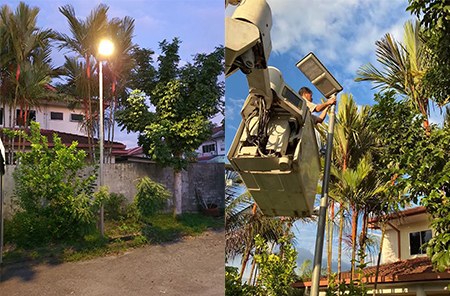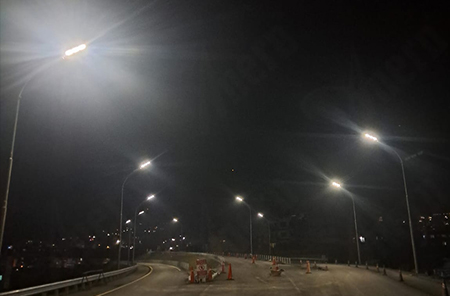
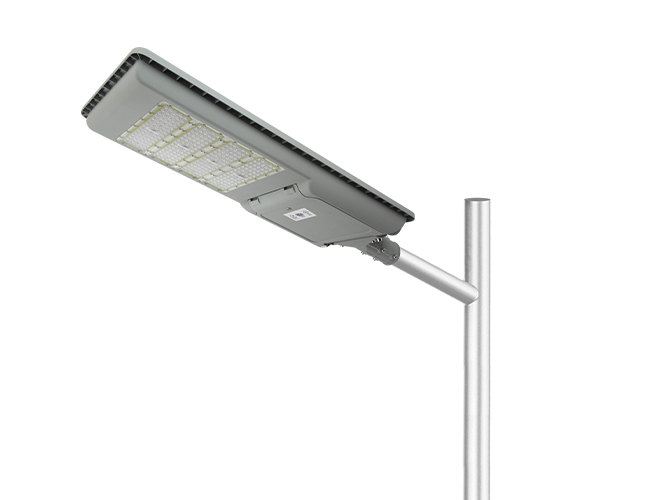
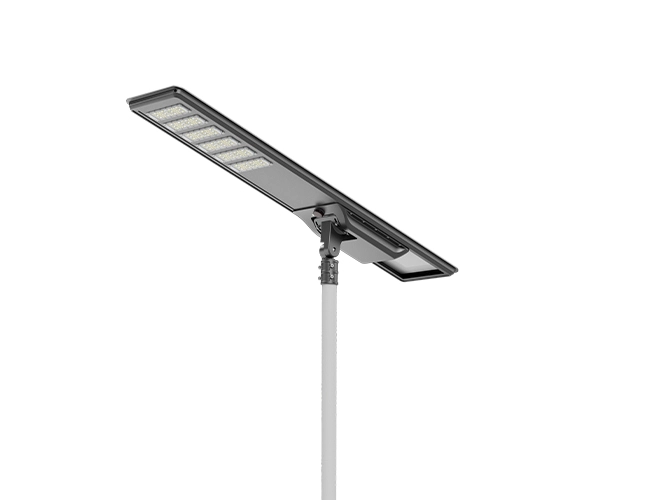
Anern’s solar street lighting projects in villages focus on providing reliable and cost-effective illumination for rural and off-grid areas. These projects are designed to improve safety, visibility, and daily life in communities where access to grid electricity is limited or unstable.
The solar street light for village emphasizes energy efficiency, easy installation, and long operating hours, ideal for rural roads, village streets, and remote residential areas across different climates.

1. When traditional grid-powered LED street lights are installed near solar street lights
The ambient light from nearby fixtures may cause the solar panel to misjudge nighttime conditions, preventing the solar light from turning on properly. Proper panel positioning and avoiding light interference are therefore critical during installation.
2. Incorrect solar panel angle adjustment
To achieve optimal charging efficiency, the tilt angle of the solar panel should be aligned with the local latitude. In many village projects, panels are installed at fixed or improper angles, resulting in reduced energy absorption and shorter lighting duration. Fine-tuning the panel angle based on regional sunlight conditions significantly improves system performance.
3. Some installation teams are unfamiliar with the functions of remote controllers
Random or incorrect parameter adjustments may lead to unstable lighting behavior. Using user-friendly controllers with preset operating modes helps ensure consistent performance and allows lighting modes to be adjusted easily and accurately.
4. Cold weather, dust, or improper installation
These issues may affect performance temporarily, but can be effectively resolved through correct panel angle optimization, regular cleaning, and proper system configuration.
Anern’s village solar light solutions are developed to address these challenges through efficient system design, durable components, and simplified maintenance.
Solar street lights are especially suitable for village and rural environments due to their independent power supply and flexible deployment.
No need for grid connection or underground cabling
Lower installation and operating costs compared to traditional street lights
Suitable for remote villages and areas with unstable electricity
Environmentally friendly and sustainable energy source
Fast installation with minimal civil works

Most village roads and pathways use 40W to 80W solar street lights, depending on road width and required brightness.
Yes. With proper battery capacity and system design, solar street lights can operate for several days without direct sunlight.
No. Anern's village solar street lights are designed for easy installation and do not require complex wiring or electrical infrastructure.
High-quality solar street lights typically have a lifespan of 8–10 years, with batteries lasting 8–10 years depending on usage and environment.
Yes. Pole height, wattage, lighting time, and control modes can be customized in Anern to meet specific village project requirements.

Make your business profitable
Zero your Electricity bill
Leading the solar solutions industry

 English
  français
  Deutsch
  Español
  italiano
  русский
  português
  العربية
  Türkçe
  Malay
Malay  Indonesia