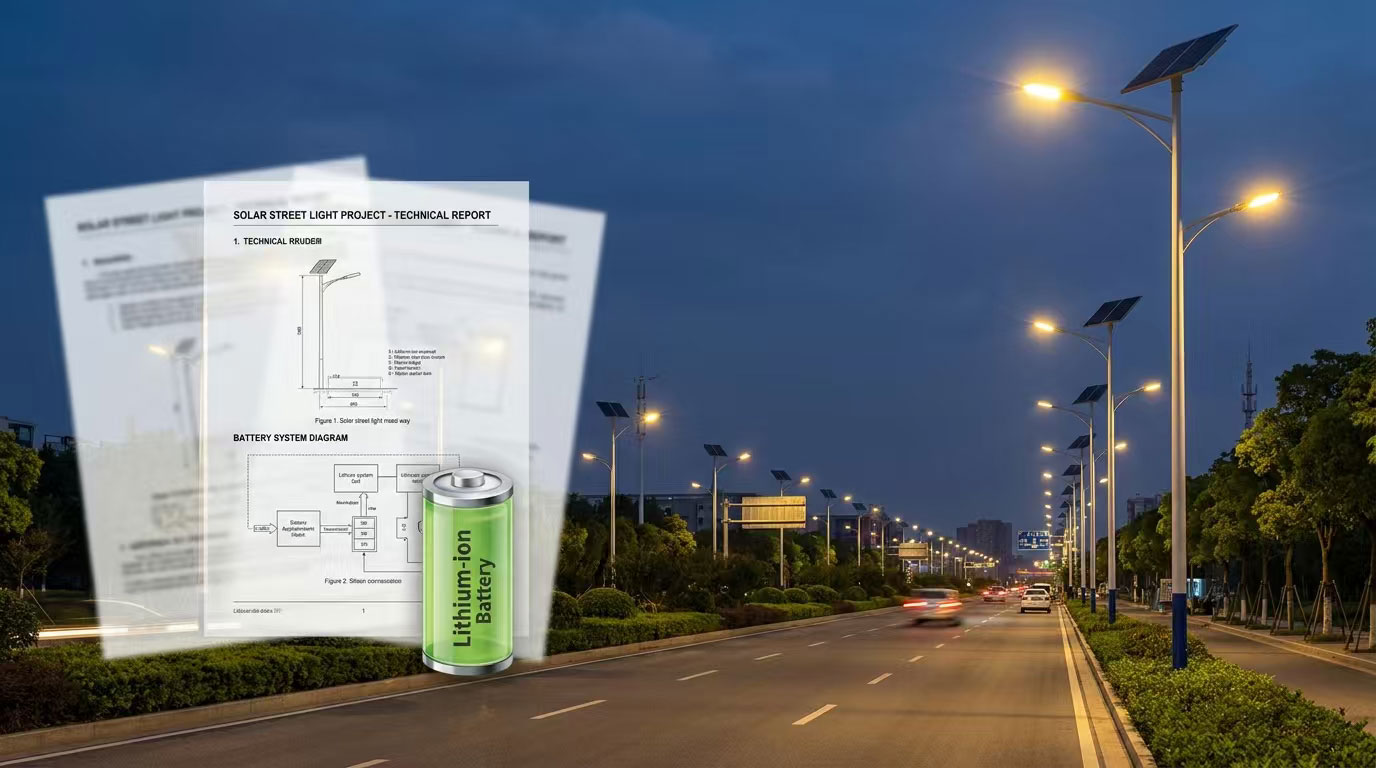
Lithium battery cell safety test summary based on IEC 62619:2017 for solar street light battery evaluation.
Reliable solar street lighting starts with a safe and stable battery. This summary evaluates safety under short circuit, drop, impact, thermal abuse, and internal short-circuit conditions.
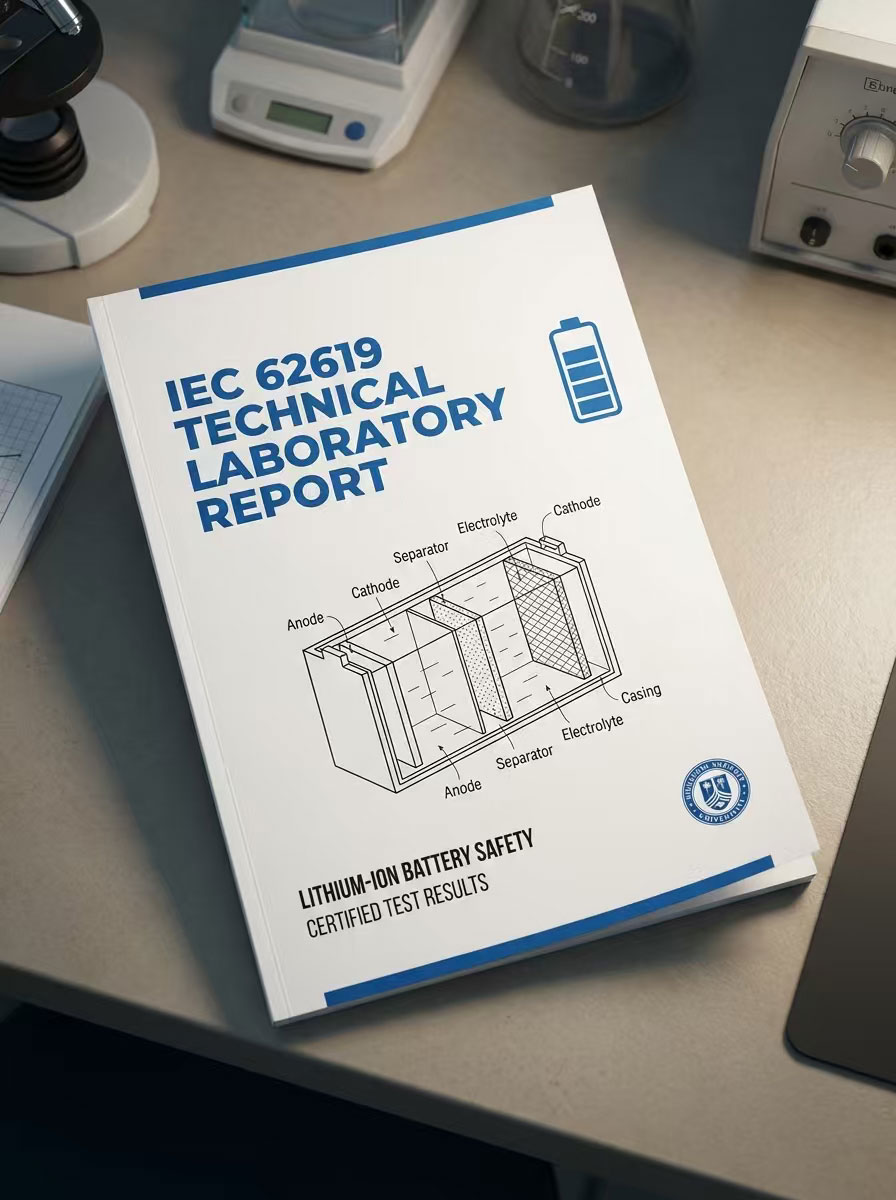
The tested product is a lithium ion rechargeable cell, model IFR32135-15Ah. It is a lithium iron phosphate battery cell with a rated capacity of 14.5Ah, rated voltage of 3.2Vdc, and energy of 46.4Wh.
The test report covers safety performance under several abnormal or reasonably foreseeable misuse conditions, including short circuit, impact, drop, thermal abuse, overcharge, forced discharge, and internal short circuit.
Lithium ion rechargeable cell
IFR32135-15Ah
Lithium Iron Phosphate / LFP
14.5Ah
3.2Vdc
46.4Wh
3.65V
3.9V
1.9V
0.268 ± 0.005kg
-30°C to 65°C
-20°C to 65°C
IEC 62619:2017 / EN 62619:2017
Main Result
PASS: No fire, No explosion
Note: This report supports the safety evaluation of the tested lithium battery cell. System performance should consider BMS, controller, and environment.
For infrastructure projects, battery safety directly affects service life, maintenance costs, and long-term project stability.
Municipal Road Lighting
Government Projects
Parking Lot Lighting
Public Infrastructure
The IEC 62619 standard involves rigorous physical and electrical stress testing.
| Test Item | What It Evaluates | Project Buyer Meaning |
|---|---|---|
| External Short-Circuit | Simulates wiring faults external to the cell | Prevents fire during installation or hardware failure |
| Impact Test | Mechanical stress via weight drop | Durability against harsh shipping or accidental impact |
| Whole Drop Test | Free fall from 1.0m to concrete | Resilience during on-site installation handling |
| Thermal Abuse Test | Exposure to temperatures up to 130°C | Safety in extreme climates and desert environments |
| Overcharge Test | Electrical stress beyond capacity limits | Protection if controller regulation fails |
| Forced Discharge Test | Evaluates battery cell behavior under abnormal reverse discharge conditions. | Helps verify safety performance when the cell experiences misuse. |
| Internal Short-Circuit Test | Designed to evaluate the safety response of the cell when an internal risk is simulated. | Key safety concern for lithium battery cells in outdoor applications. |
According to the test report, the applicable test results showed no fire and no explosion. This indicates that the tested lithium battery cell met the relevant safety requirements under the listed IEC 62619 test conditions.
Electrical Safety
Mechanical Safety
Thermal Safety
Ensure your solar street light projects use the correct battery specifications for longevity.
Verify over-charge, over-discharge, and thermal cut-off points.
Match charge current to solar panel output peaks.
Check if the battery casing is IP67 for pole mounting.
Demand discharge curve reports for specific cell models.
A solar street light battery test evaluates whether the battery cell or battery system can operate safely under electrical, mechanical, and thermal stress conditions such as short circuit, overcharge, impact, drop, and high temperature.
For solar lithium batteries, IEC 62619 is a commonly used safety standard. The uploaded report is based on IEC 62619:2017 / EN 62619:2017.
No. The report is for a lithium ion rechargeable cell, not the complete solar street light system. This distinction should be clearly stated on the page to avoid overclaiming.
Solar street lights operate outdoors for years and are exposed to extreme conditions. Battery safety affects system reliability, maintenance cost, and project stability.
Our engineering team provides custom lithium battery configurations optimized for your specific project climate and lighting requirements.

Make your business profitable
Zero your Electricity bill
Leading the solar solutions industry

 English
  français
  Deutsch
  Español
  italiano
  русский
  português
  العربية
  Türkçe
  Malay
Malay  Indonesia