Choosing between a 100W solar street light and a 150W solar street light is an important decision for contractors, distributors, and project developers who need reliable outdoor lighting solutions. Although both wattage options use solar energy to provide illumination, they are designed for different lighting requirements and application environments.
The main difference between 100W and 150W solar street lights is the lighting output. A 150W system generally provides stronger illumination and higher energy requirements, while a 100W system focuses on balanced performance, energy efficiency, and cost control.
However, higher wattage does not always mean a better solution. The right choice depends on factors such as road conditions, lighting area, installation height, sunlight availability, and expected working hours.
As an experienced solar street light manufacturer, Anern provides various solar lighting solutions, including All-In-One Solar Street Light and All-In-Two Solar Street Light, to meet different project requirements from residential lighting to commercial and infrastructure applications.
Understanding the differences between 100W and 150W solar street lights helps buyers select a suitable system that provides reliable lighting performance while optimizing project investment.
The primary difference between a 100W and 150W solar street light is the LED power output. A 150W model delivers higher lighting output compared with a 100W model, which makes it suitable for projects requiring stronger illumination.
However, solar street light performance depends on more than LED wattage. A complete solar lighting system includes:
LED lighting module
Solar panel
Battery
Controller
Lighting structure
The solar panel capacity and battery configuration determine how effectively the system can collect and store solar energy for nighttime operation.
A 100W solar street light is generally suitable for applications requiring standard lighting performance. It provides a balance between brightness, energy consumption, and system cost.
A 150W solar street light is designed for applications that require higher illumination levels and stronger lighting coverage.
For professional projects, buyers should evaluate the complete system configuration instead of selecting a product only based on wattage.
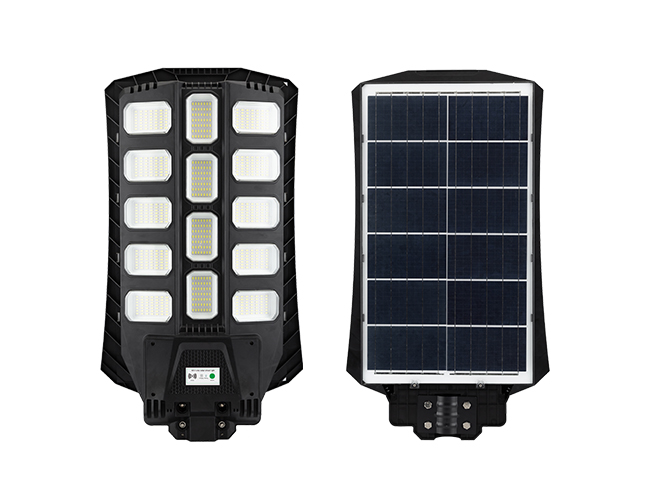
A 100W solar street light is a popular choice for outdoor lighting projects that require reliable performance with efficient energy usage.
Compared with higher-power models, 100W solar street lights offer advantages such as:
Lower energy requirements
Efficient operation
Easier installation
Cost-effective lighting performance
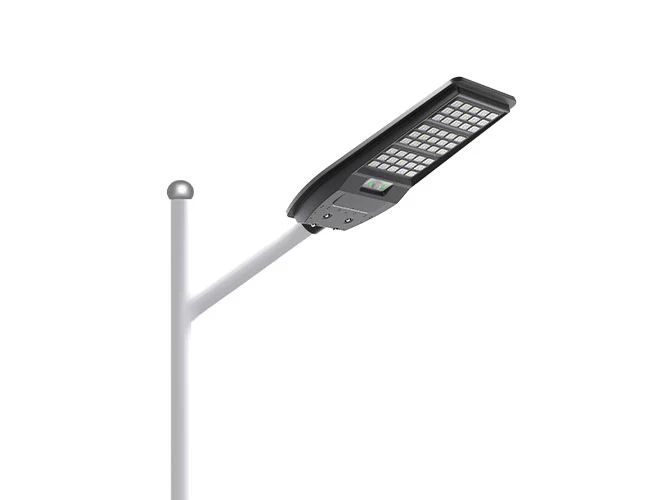
Anern’s integrated solar lighting solutions combine the solar panel, battery, LED module, and controller into one compact design. The All-In-One Solar Street Light is suitable for projects where simple installation and integrated structure are important.
Typical applications include:
Rural roads
Residential communities
Pedestrian areas
Parks
Small outdoor lighting projects
For these applications, a 100W solar street light can provide sufficient illumination while maintaining good energy efficiency.
The compact structure also helps reduce installation complexity, making it suitable for projects where fast deployment and low maintenance are important considerations.
A 150W solar street light provides higher lighting output compared with a 100W model and is suitable for projects that require stronger illumination performance.
![150w-solar-street-light[1].jpg](/uploads/image/20260729/150w-solar-street-light[1].jpg "/uploads/image/2026/07/29/150w-solar-street-light[1].jpg")
The main advantages of a 150W solar street light include:
Higher LED output
Stronger lighting coverage
Higher energy capacity requirements
Better suitability for larger lighting areas
For projects with wider roads, higher brightness requirements, or longer operation time, a 150W configuration can provide better lighting performance.
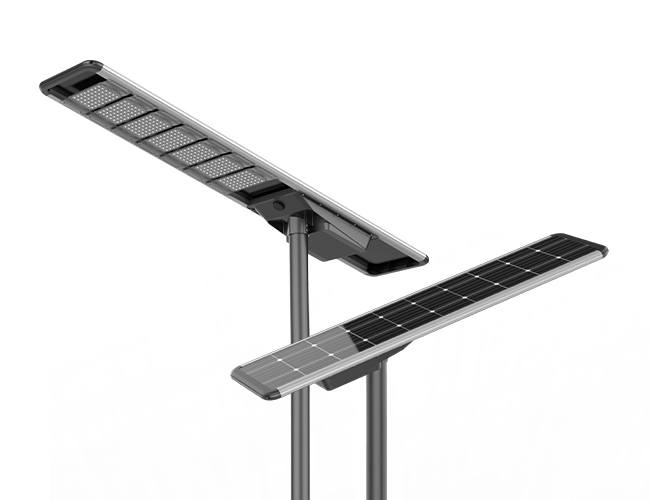
Anern offers different solar street light designs to meet various application needs. The All-In-Two Solar Street Light uses a semi-split structure that separates the solar panel from the lighting module, providing more flexibility for system configuration.
Typical applications include:
Urban roads
Commercial areas
Industrial parks
Municipal lighting projects
Compared with lower-power solutions, a 150W solar street light can better support applications requiring stronger illumination and wider coverage.
When comparing 100W and 150W solar street lights, buyers should consider several important factors.
| Factor | 100W Solar Street Light | 150W Solar Street Light |
|---|---|---|
| Lighting Output | Standard lighting performance | Higher lighting output |
| Coverage Area | Suitable for smaller and medium areas | Suitable for larger lighting areas |
| Energy Requirement | Lower | Higher |
| System Configuration | Standard solar panel and battery configuration | Higher capacity configuration |
| Installation Requirement | Simple deployment | Suitable for projects requiring stronger performance |
| Cost | More economical | Higher investment for increased performance |
A 100W solar street light is usually a better choice when:
The lighting requirement is moderate
The project focuses on energy efficiency
The installation area is relatively limited
Cost control is an important factor
A 150W solar street light is more suitable when:
Higher brightness is required
The lighting area is larger
Longer operation time is needed
The project requires stronger lighting performance
The best choice depends on the actual project conditions rather than simply selecting the higher wattage product.
Before choosing between a 100W and 150W solar street light, buyers should evaluate several key factors.
Consider:
Road width
Required brightness
Lighting distance
Working hours
Different applications require different lighting levels. A residential road may not require the same power level as a commercial or municipal project.
The local sunlight conditions affect solar panel and battery configuration.
Projects in areas with sufficient sunlight may achieve reliable performance with standard configurations, while areas with limited sunlight may require larger energy storage capacity.
The product structure also affects system performance.
For projects requiring a compact and easy-to-install solution, an All-In-One Solar Street Light can provide advantages through integrated design.
For projects requiring stronger performance and more flexible solar panel configuration, an All-In-Two Solar Street Light can be a suitable option.
Working with an experienced solar street light manufacturer like Anern helps buyers select the appropriate wattage and configuration according to specific project requirements.
Both 100W and 150W solar street lights have their own advantages. A 100W solar street light provides an efficient and cost-effective solution for projects requiring standard outdoor lighting performance.
A 150W solar street light offers stronger illumination and is more suitable for applications requiring higher lighting output and wider coverage.
The best choice depends on project requirements, installation conditions, lighting expectations, and system configuration. By evaluating these factors carefully, contractors, distributors, and project owners can select a solar lighting solution that delivers reliable long-term performance.
Anern continues to provide professional solar street lighting solutions with different wattage options to support various outdoor lighting projects worldwide.

Make your business profitable
Zero your Electricity bill
Leading the solar solutions industry

 English
  français
  Deutsch
  Español
  italiano
  русский
  português
  العربية
  Türkçe
  Malay
Malay  Indonesia