Choosing the right solar street light is an important decision for contractors, distributors, government organizations, and infrastructure developers. Different solar street light designs have different advantages in terms of installation, lighting performance, maintenance, battery capacity, and project cost.
Currently, the market mainly offers three types of solar street lights:
All-In-One Integrated Solar Street Light
All-In-Two Semi-Split Solar Street Light
Split Solar Street Light
Although these systems all use solar energy to provide outdoor lighting, their structures are different. The right choice depends on project requirements, including road conditions, lighting demand, installation environment, and long-term maintenance plans.
As an experienced solar street light manufacturer, Anern provides various solar lighting solutions for rural roads, urban streets, highways, commercial areas, and government projects. Understanding the differences between these designs helps buyers select the most suitable solution.
Solar street lights are mainly classified according to how the solar panel, battery, LED lamp, and controller are arranged.
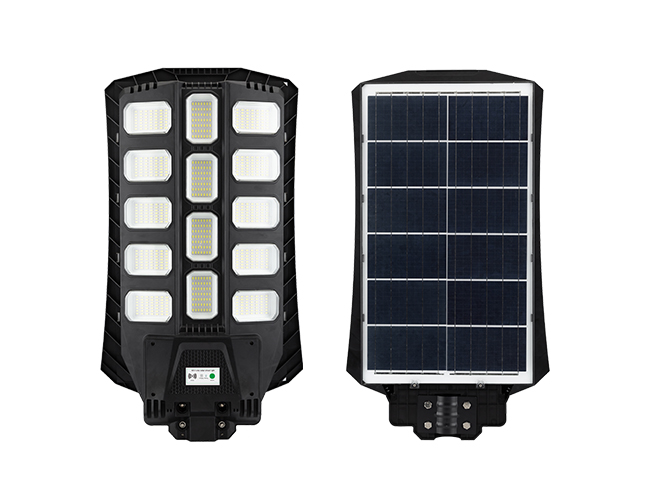
An All-In-One Solar Street Light integrates all components into one compact unit, including:
Solar panel
Lithium battery
LED lighting module
Intelligent controller
This design focuses on simplicity, compact size, and easy installation.
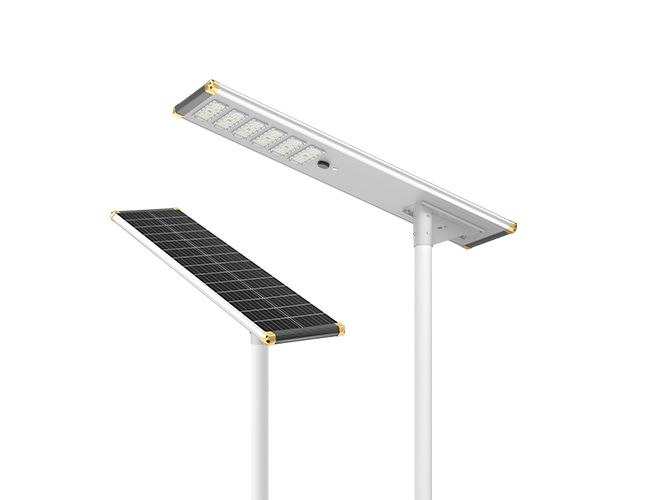
An All-In-Two Solar Street Light separates the solar panel from the LED lamp and battery module.
Compared with All-In-One systems, it allows:
Larger solar panels
Higher charging efficiency
Greater lighting capacity
A Split Solar Street Light separates the solar panel, battery, and LED lamp completely.
This design provides maximum flexibility and is commonly used for large-scale engineering projects requiring customized configurations.
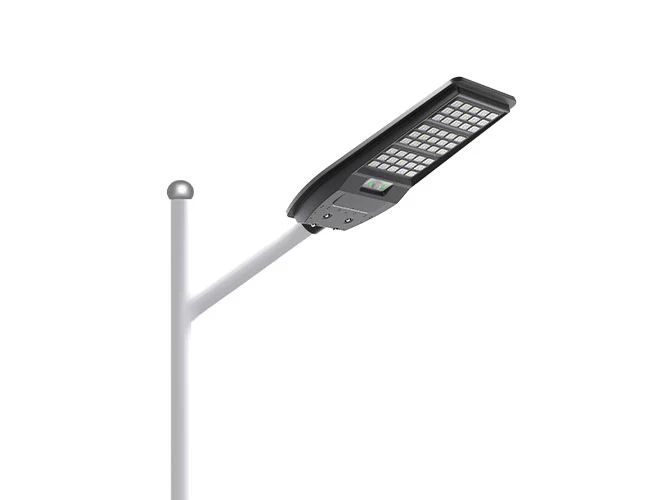
An All-In-One Solar Street Light combines all major components into a single housing. It is designed to simplify installation and reduce the complexity of solar lighting projects.
During the daytime, the solar panel converts sunlight into electricity and stores energy in the battery. At night, the controller automatically powers the LED lamp to provide outdoor illumination.
Simple Installation
Because all components are integrated, installation is faster compared with traditional solar street lights.
Advantages include:
Less wiring work
Reduced installation time
Lower labor requirements
Easier transportation
This makes All-In-One systems especially suitable for remote areas where construction resources are limited.
Lower Maintenance Requirements
The integrated structure reduces the number of external components and connection points. This can help simplify maintenance and improve system reliability.
Suitable Applications
All-In-One solar street lights are commonly used for:
Village roads
Residential communities
Parks
Pedestrian walkways
Small parking areas
Rural lighting projects
However, because the solar panel and battery size are limited by the compact design, extremely large projects with high lighting requirements may need a more powerful solution.
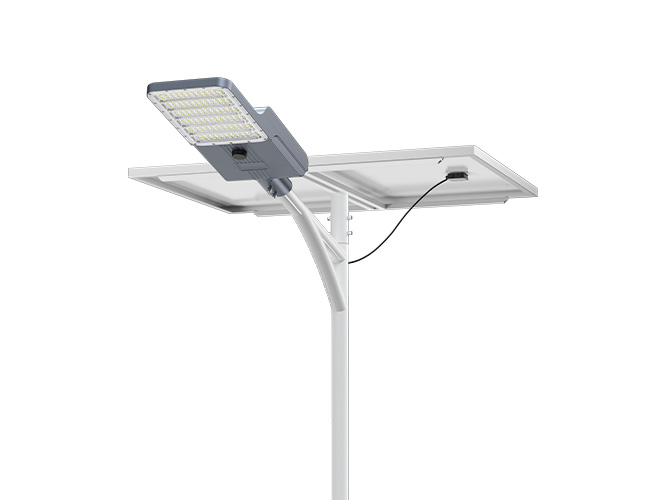
An All-In-Two Solar Street Light is designed with a separated solar panel and lighting module.
Unlike All-In-One systems, the solar panel can be installed independently, providing more flexibility in solar energy collection.
Higher Solar Charging Efficiency
The separated solar panel allows the system to use a larger photovoltaic module.
Benefits include:
Better sunlight absorption
Higher energy generation
Improved performance in areas with changing weather conditions
Stronger Lighting Performance
All-In-Two solar street lights can support:
Higher LED power
Larger battery capacity
Longer lighting duration
This makes them suitable for projects requiring more reliable nighttime illumination.
Flexible Project Applications
All-In-Two systems are widely used for:
Urban roads
Highways
Industrial parks
Commercial areas
Municipal projects
They provide a balance between easy installation and strong performance.
A Split Solar Street Light is the traditional solar lighting structure where each component is installed separately.
The solar panel, battery, and LED lamp can be selected according to specific project requirements.
Maximum Customization
The biggest advantage of split systems is customization.
Engineers can adjust:
Solar panel capacity
Battery size
LED power
Installation position
This makes them suitable for complex projects requiring customized solar lighting solutions.
Typical Applications
Split solar street lights are commonly used for:
Highways
Large government projects
Industrial facilities
Remote areas
Large infrastructure projects
The disadvantage is that installation is more complicated and requires more engineering work.
| Factor | All-In-One | All-In-Two | Split |
|---|---|---|---|
| Structure | All components integrated | Solar panel separated | Components fully separated |
| Installation | Easy and fast | Moderate | More complex |
| Cost | Lower | Medium | Higher |
| Maintenance | Simple | Moderate | More complicated |
| Solar Panel Size | Limited | Larger flexibility | Fully customizable |
| Battery Capacity | Medium | Higher | Flexible |
| Lighting Power | Small to medium | Medium to high | High-power applications |
| Best Application | Villages, parks, small roads | Roads, highways, commercial projects | Large engineering projects |
Different applications require different solar street light designs.
Recommended: All-In-One Solar Street Light
Village projects usually focus on:
Simple installation
Wide coverage
Low maintenance
An integrated solar street light is often the most practical choice.
Recommended: All-In-One or All-In-Two
For small parking areas, All-In-One systems can provide sufficient lighting.
For large commercial parking lots, All-In-Two systems may offer better brightness and longer operation time.
Recommended: All-In-Two or Split Solar Street Light
Highway lighting requires:
Higher brightness
Stable operation
Longer backup time
Larger solar panels and batteries provide better performance.
Recommended: All-In-Two or Split Solar Street Light
Government projects usually consider:
Long service life
Reliable operation
Large-scale deployment
Engineering flexibility
When selecting a solar street light, buyers should consider:
Evaluate:
Sunlight conditions
Weather conditions
Installation location
Consider:
Road width
Pole height
Required brightness
Working hours
Remote projects usually benefit from simple and reliable systems with fewer maintenance requirements.
Choose All-In-One Solar Street Light If:
You need fast installation
The project has standard lighting requirements
Cost efficiency is important
Choose All-In-Two Solar Street Light If:
You need stronger lighting performance
Longer lighting hours are required
Better solar charging efficiency is needed
Choose Split Solar Street Light If:
The project requires customization
The application is large-scale
Engineering requirements are complex
There is no single best solar street light design for every project.
All-In-One solar street lights are ideal for simple and cost-effective applications. All-In-Two solar street lights provide a balance between installation convenience and higher performance. Split solar street lights offer maximum flexibility for customized engineering projects.
By understanding the differences between these three designs, project owners, contractors, and distributors can choose the right solar lighting solution for reliable and long-term outdoor illumination.
1. What is the difference between All-In-One and All-In-Two solar street lights?
The main difference is the structure. An All-In-One solar street light integrates all components into one housing, while an All-In-Two solar street light separates the solar panel from the lighting module.
2. Which solar street light is better for highways?
All-In-Two and Split Solar Street Lights are generally more suitable for highways because they support larger solar panels, higher battery capacity, and stronger lighting output.
3. Are All-In-One solar street lights suitable for government projects?
Yes. They are suitable for many public lighting projects. However, large municipal projects often prefer All-In-Two or split systems because they provide greater flexibility.
4. How do I choose a reliable solar street light manufacturer?
A professional manufacturer should provide:
Manufacturing capability
Technical support
Product certifications
Project experience
Installation guidance


Bob Wu is a solar engineer at Anern, specialising in solar street lighting and off-grid systems. With over 15 years of experience in renewable energy solutions, he designs and optimises solar-powered lighting and energy systems for global projects. His expertise ensures efficient, sustainable and cost-effective solar implementations.

Make your business profitable
Zero your Electricity bill
Leading the solar solutions industry

 English
  français
  Deutsch
  Español
  italiano
  русский
  português
  العربية
  Türkçe
  Malay
Malay  Indonesia