Choosing the right panel size for a solar panel street light is an energy-balance problem, not a simple watt-for-watt match between the LED and solar module. The panel must generate enough daytime energy to replace what the light consumes at night, while also covering charging losses and recovering the battery after low-solar days.
That means LED power is only one input. Operating hours, dimming strategy, local solar radiation, weather, battery autonomy, panel orientation and shading all influence the final design. Anern likewise lists daily LED consumption, local peak sun hours, backup-day requirements and system efficiency among the variables used for project sizing.

A 100W LED does not automatically need a 100W solar panel. The actual requirement depends on how much energy that LED consumes over the entire night.
Consider three operating strategies:
Shorter operating time: A 100W lamp operating for 6 hours consumes much less energy than the same lamp operating for 12 hours.
Full-night operation: Longer lighting schedules increase daily battery discharge and therefore increase the energy that the panel must replace.
Dimming profiles: A lamp operating at 100% output early in the evening and reduced output later can consume significantly less energy than continuous full-power operation.
Smart solar street lights can vary output during low-traffic periods specifically to reduce energy consumption and battery demand.
So the first question for a solar panel LED street light should not be “What is the LED wattage?” but “How many watt-hours does the complete nightly operating profile require?”
The basic sizing logic starts with nightly consumption:
Nightly Load ≈ LED Power × Effective Operating Hours
The solar module must then generate enough energy during the following day to replace that consumption. A simplified relationship is:
Required Solar Energy ≈ Nightly Energy Load ÷ Overall System Efficiency
System efficiency matters because not every watt-hour produced by the panel reaches the battery and later becomes useful LED energy. Controller operation, wiring, charging and environmental conditions introduce losses.
A preliminary energy comparison might look like this:
| Design Variable | Effect on Required Solar Generation |
|---|---|
| Higher LED power | Increases energy demand |
| Longer operating hours | Increases energy demand |
| Stronger night dimming | Reduces energy demand |
| Lower system efficiency | Requires more panel generation |
| More cloudy-day recovery | Requires additional charging margin |
This is why a solar panel street light project should be sized from daily energy demand rather than from LED wattage alone.
One of the most important concepts in solar sizing is the difference between daylight hours and peak sun hours.
A location may have 10 or 12 hours between sunrise and sunset, but sunlight intensity is not constant throughout that period. Early morning and late-afternoon irradiance are much weaker than midday solar radiation.
NREL defines a peak sun hour as the equivalent solar energy received during one hour at an irradiance of 1,000 W/m². In other words, several hours of weaker sunlight may add up to only a few equivalent peak sun hours.
For a solar panel street light, panel sizing should therefore use local solar-resource data rather than assuming that every daylight hour produces rated panel power.
If one location has strong solar resources and another has significantly fewer effective peak sun hours, the same nightly load may require different panel sizes.
Solar availability changes by location and season, which is why one universal panel wattage cannot work for every project.
A tropical region may receive strong annual solar radiation but also experience extended rainy periods. A cloudy coastal climate may have lower effective solar generation. At higher latitudes, shorter winter days and lower seasonal solar irradiance can become the limiting design condition.
For project engineering, it is usually more useful to consider the difficult operating season rather than sizing only around ideal sunny-day conditions.
Anern's solar street-light customization process similarly considers project location, latitude, solar radiation, climate conditions and rainy-day autonomy when configuring the panel and battery system.
This means identical solar panel LED street light systems installed in two countries may require different panel and battery configurations even when the LED wattage is the same.
The solar panel must sometimes do more than provide enough energy for the next night. After several cloudy or rainy days, it may also need to restore energy that has already been removed from the battery.
During recovery, the charging system may effectively need to support two demands:
Replace the energy required for the coming night, so normal lighting can continue.
Restore part of the battery reserve, rebuilding the autonomy used during previous low-solar days.
Work within available peak sun hours, because the recovery energy must be collected during a limited charging window.
This is why additional panel capacity can be valuable in projects requiring several days of battery autonomy.
However, simply installing the largest possible panel is not the objective. Panel size should be coordinated with battery capacity, controller limits and the required recovery period.
The panel and battery are therefore two sides of the same energy-balance calculation.

Rated solar-panel wattage is measured under defined conditions, while real outdoor generation depends on the sunlight actually reaching the module.
Shading from trees, buildings, poles or other objects can reduce available solar energy. Panel orientation and tilt also influence how effectively the module receives solar radiation during the relevant season.
This is particularly important for a street light with solar panel and battery because the available mounting location may be constrained by road direction and surrounding infrastructure.
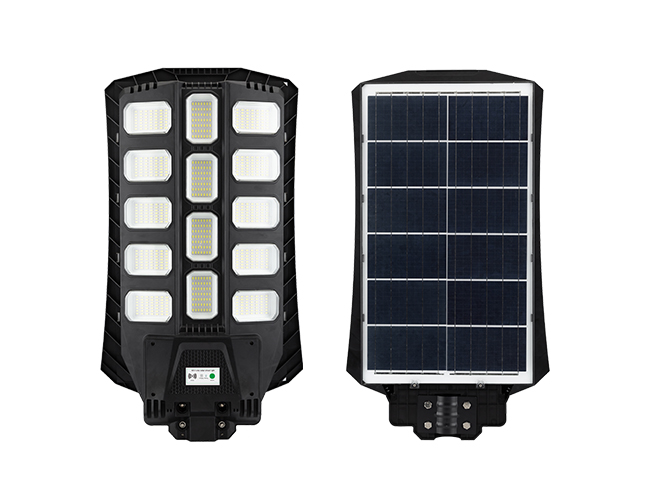
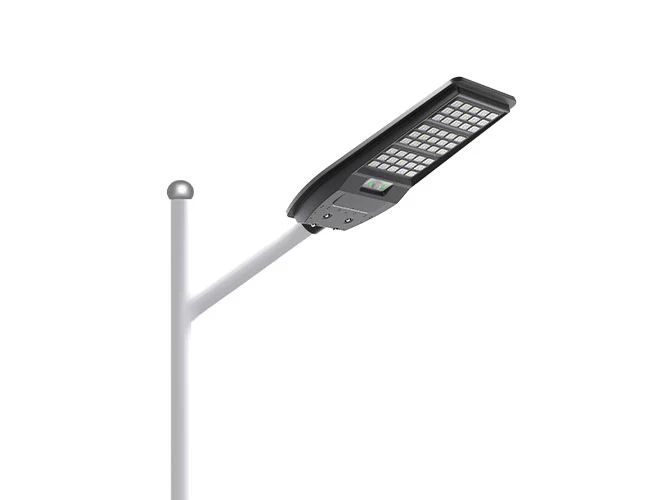
Anern's AN-SL all-in-two design allows the solar-panel size to be changed according to project requirements and permits panel orientation to be adjusted independently according to road conditions.
Its AN-SSL-T range also demonstrates that panel capacity is matched to the complete system rather than copied directly from LED wattage: published configurations pair 60W, 80W, 100W and 120W LED options with 80W, 100W, 150W and 200W solar panels respectively, together with different battery capacities.
The correct panel size for a solar panel street light cannot be determined from LED wattage alone.
Nightly energy consumption establishes the load, while peak sun hours determine how much useful charging time is available. Weather, seasonal irradiance, battery autonomy, recovery requirements, shading, orientation and system losses then modify the required panel capacity.
A well-designed solar panel street light project therefore matches the panel, battery, controller and LED as one energy system. The goal is not to install the biggest panel, but to generate enough reliable daily energy for the required lighting schedule and local environment.
It depends on nightly energy consumption, peak sun hours, system efficiency, battery autonomy and local solar conditions.
Not necessarily. Operating hours, dimming and available solar radiation determine the actual panel requirement.
Peak sun hours represent daily solar energy expressed as equivalent hours at 1,000 W/m² irradiance.
Additional charging capacity may be useful where the system needs to maintain operation and recover battery energy after extended low-solar periods.
Shading reduces the solar energy reaching the panel, which can reduce daily charging and make it harder to restore the battery fully.

Bob Wu is a solar engineer at Anern, specialising in solar street lighting and off-grid systems. With over 15 years of experience in renewable energy solutions, he designs and optimises solar-powered lighting and energy systems for global projects. His expertise ensures efficient, sustainable and cost-effective solar implementations.

Make your business profitable
Zero your Electricity bill
Leading the solar solutions industry

 English
  français
  Deutsch
  Español
  italiano
  русский
  português
  العربية
  Türkçe
  Malay
Malay  Indonesia