Calculating the number of lights for a solar street light project is not as simple as dividing road length by pole spacing. That formula is useful for an initial estimate, but the final quantity also depends on pole arrangement, road width, intersections, curves, starting and ending positions, and lighting uniformity.
For a reliable solar light project, the correct sequence should be:
Lighting requirement → layout → pole spacing → quantity
This prevents a common mistake: deciding how many lights the budget can buy first and then stretching the spacing to make them cover the entire road.
A basic preliminary formula is:
Approximate Quantity = Road Length ÷ Average Pole Spacing
For example, a 1,000 m road with preliminary 30 m spacing gives about 33 spacing units.
However, this does not mean the project automatically requires 33 lights. Pole spacing measures the distance between fixtures, while the actual design must also determine where the first pole begins and where the last pole is positioned.
Intersections, curves or entrances may also require additional lighting positions.
Therefore, this formula is useful for early budgeting, but the final solar street light project quantity should always come from the completed road-lighting layout.
The number of spacing intervals and the number of poles are not always the same.
For a 1,000 m road with around 30 m spacing, the project may require approximately 34 intervals to cover the entire section. If there is a fixture near both the beginning and end of the road, the number of pole positions may already be closer to 35 before special areas are considered.
Several factors can change the total:
Start and end positions: The first and last lights must provide adequate coverage at both ends of the project.
Road entrances and junctions: Regular spacing may need to be adjusted around access points.
Physical obstacles: Drainage, trees, utilities or structures may force poles to move.
Transition areas: Bridges or connections to existing lighting may require different placement.
This is why a solar lamp project should treat road length divided by spacing as an estimate, not a final purchasing quantity.
The same road length can require very different numbers of lights depending on the installation arrangement.
A single-side layout places all poles along one side of the road. It can work well on narrower roads if the luminaire distributes enough light across the carriageway.
A staggered layout alternates poles from one side to the other. This can improve coverage on wider roads, but the definition of spacing must be clear. A 30 m spacing may mean 30 m between successive luminaires along the road, not 30 m between poles on each individual side.
An opposite-side layout installs poles on both sides of the road. If one side requires about 35 poles, a symmetrical two-sided layout may require close to twice that quantity.
For this reason, every solar street light project estimate should state both the spacing and pole arrangement.
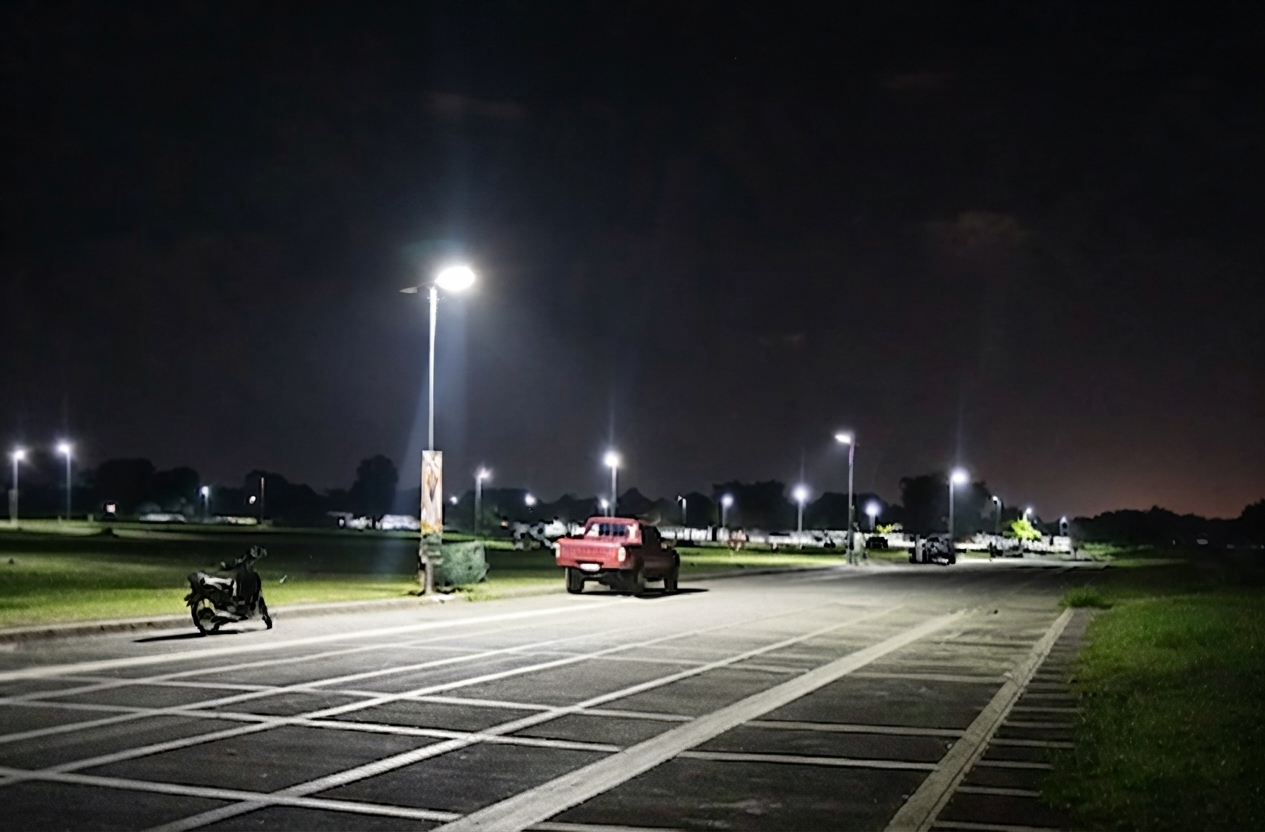
Roads are rarely perfectly straight from beginning to end. Special areas often require local adjustments because their visibility and geometry differ from ordinary road sections.
Intersections may require additional lighting because traffic approaches from multiple directions.
Curves change sight lines and may require different pole positioning.
Pedestrian crossings may need stronger localized visibility.
Entrances and turning areas can create wider illuminated zones than the normal carriageway.
A real solar light project may therefore use regular spacing along most of the road while adding or repositioning lights around these special areas.
These lights should not be considered unnecessary extras. They are part of adapting the lighting layout to actual road conditions.
Pole quantity depends directly on spacing, so spacing needs to be technically justified before the final order quantity is decided.
Road width, pole height, optical distribution, target illuminance and required uniformity all influence how far apart luminaires can be installed.
Increasing spacing may reduce equipment and installation costs, but excessive spacing can create dark areas between poles. Installing more lights than necessary, on the other hand, increases foundation, transport and equipment costs without always improving lighting quality proportionally.
The correct question is therefore not:
How many lights can the project budget buy?
It should be:
What spacing provides the required lighting performance, and how many lights does that layout require?
Quantity should be the result of engineering design.
Consider a simplified 1 km road project:
| Item | Preliminary Design |
|---|---|
| Road length | 1,000 m |
| Pole height | 8 m |
| Preliminary spacing | 30 m |
| Layout | Staggered |
| Basic spacing intervals | About 34 |
| Initial pole positions | About 35 |
| Special condition | One intersection |
| Planning quantity | About 37 lights |
The normal road section may require approximately 35 lighting positions. If the intersection requires two additional positions, the preliminary project quantity becomes around 37 solar street lights.
This is only an example. A wider road, different optical distribution or opposite-side layout could produce a very different quantity.
Anern provides Street Light Calculator tools, IES files and DIALux simulation support that can help evaluate road width, pole height, spacing and final lighting performance before the quantity is confirmed.
The final step in a professional solar street light project is verifying whether the proposed layout actually delivers the required illumination and uniformity.
IES files describe how a specific luminaire distributes light. When this data is used in DIALux, designers can evaluate how neighboring lights overlap and whether dark zones appear between poles.
This matters because two solar street lights with similar wattage can produce very different road-lighting patterns.
Photometric simulation therefore helps confirm whether the proposed pole spacing, arrangement and quantity work together before equipment is purchased and installed.
The number of fixtures required for a solar street light project should not be calculated from road length alone.
Road length and preliminary spacing provide a useful first estimate, but final quantity also depends on pole arrangement, endpoints, intersections, road width and photometric performance.
The correct approach is to determine the lighting requirement first, establish the layout and spacing second, and calculate quantity last.
For a professional solar lamp project, the quantity should follow the lighting design—not control it.
There is no fixed number. It depends on spacing, road width, pole arrangement and lighting requirements.
Start with road length divided by preliminary spacing, then adjust for endpoints, intersections and layout type.
Yes, but spacing must first satisfy the lighting and uniformity requirements of the solar street light project.
They may require additional or repositioned lights because their road geometry and visibility needs are more complex.
Yes, especially for projects with defined illuminance and uniformity requirements.


Bob Wu is a solar engineer at Anern, specialising in solar street lighting and off-grid systems. With over 15 years of experience in renewable energy solutions, he designs and optimises solar-powered lighting and energy systems for global projects. His expertise ensures efficient, sustainable and cost-effective solar implementations.

Make your business profitable
Zero your Electricity bill
Leading the solar solutions industry

 English
  français
  Deutsch
  Español
  italiano
  русский
  português
  العربية
  Türkçe
  Malay
Malay  Indonesia