Battery capacity is one of the most important design variables in a solar street light with battery and panel, because the battery must store enough daytime solar energy to operate the LED through the night and maintain useful backup during periods of weak sunlight.
But battery sizing cannot be judged from an Ah number alone. Voltage, nightly energy demand, dimming strategy, rainy-day autonomy, usable depth of discharge, and solar-panel charging capacity all affect the real result. A properly designed street light with solar panel and battery is therefore an energy-balance system, not simply a lamp fitted with the largest possible battery.

Battery specifications commonly show amp-hours (Ah), voltage (V), and sometimes watt-hours (Wh). These values describe different things.
The most useful basic relationship is:
Battery Energy (Wh) = Battery Voltage (V) × Capacity (Ah)
This means two 100Ah batteries should not automatically be considered equivalent.
| Battery Example | Rated Capacity | Nominal Energy |
|---|---|---|
| 12V battery | 100Ah | 1,200Wh |
| 24V battery | 100Ah | 2,400Wh |
| 12V battery | 150Ah | 1,800Wh |
Wh is therefore more useful than Ah alone when comparing how much nominal energy different battery systems can store.
This is particularly relevant when comparing a solar street light with inbuilt battery and panel with a semi-integrated or split system, because different products may operate at different battery voltages and configurations.

Battery sizing should begin with the energy the street light is expected to consume during one night.
A simple starting calculation is:
Nightly Energy = LED Power × Operating Hours
If a 100W LED actually operated at full 100W output for 12 hours, the theoretical LED load would be 1,200Wh.
However, this is rarely the complete design calculation.
Modern solar street lights can use programmed operating profiles rather than maintaining maximum output all night. Controller consumption and system losses must also be considered when converting the LED load into the battery energy required.
For this reason, the nameplate wattage of a luminaire should not automatically be multiplied by 12 hours and treated as the final battery requirement.
The real operating schedule matters.
Intelligent control can significantly change the nightly energy requirement of a solar street light with battery and panel. Anern offers solar street-light models with time-control and motion-sensing options rather than requiring continuous full-power operation.
For example, an operating strategy could use:
100% output during high-traffic evening hours, when road activity and visibility requirements are highest.
70% output later at night, when traffic begins to decrease.
40% output during low-traffic periods, reducing energy consumption while maintaining basic illumination.
Motion-triggered higher output, where suitable, allowing the luminaire to increase brightness temporarily when activity is detected.
A 100W luminaire following this type of profile consumes much less energy than the same luminaire operating continuously at 100W.
Dimming therefore does more than extend runtime. It can influence the required battery capacity and solar-panel charging demand.
A solar street light is normally designed to operate for more than one normal night because solar charging varies with weather.
This reserve is often described as autonomy: how long the system can continue operating when solar energy is insufficient to fully recharge the battery.
A project might be designed around one night of reserve, two nights, or several consecutive low-solar days. There is no universal autonomy requirement because climate, project importance, seasonal solar conditions, and acceptable dimming strategies differ by location.
If nightly usable energy consumption were 600Wh, three nights would theoretically require 1,800Wh before allowances for usable battery capacity and system losses are included.
This is why rainy-season projects should not compare batteries only by their nominal Ah rating. The relevant question is how much usable stored energy remains available across the required backup period.
The energy printed on the battery label is nominal capacity. A real street light with solar panel and battery should not assume that every watt-hour can always be used under every condition.
Several factors reduce or change usable energy:
Depth of discharge: Battery systems normally maintain a lower discharge limit rather than repeatedly treating 100% of nominal capacity as available. Depth of discharge also affects lithium battery cycle life.
Temperature: Battery capacity and performance can change with operating temperature, so climate should be considered in system design.
Battery aging: Available capacity gradually changes over the battery's service life.
Controller protection: The control system may disconnect the load before extreme discharge to protect the battery.
System losses: Controllers, wiring, and power conversion mean stored battery energy is not converted into LED light with perfect efficiency.
This distinction between rated capacity and usable capacity is one reason simply choosing the highest Ah specification can be misleading.
Installing a larger battery does not automatically create a better solar street light.
The solar panel must be capable of replacing the energy removed from the battery. If the battery becomes larger while panel charging capacity remains insufficient, the system may take too long to recover after several poor-weather days.
Solar-panel size, local peak-sun conditions, charging efficiency, daily energy consumption, and required recovery time therefore need to be considered together.
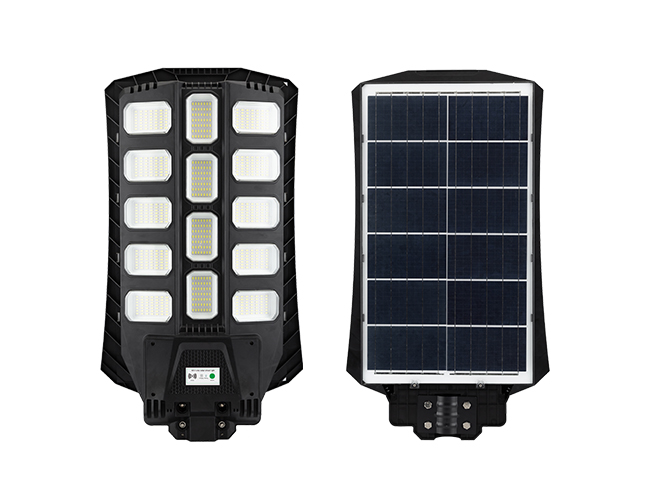
Anern's All-in-Two SSL-I illustrates this system approach. Its larger battery-box design can accommodate configurations up to 12V 150Ah, while the separate solar-panel configuration is intended to support higher brightness and longer backup requirements. Other semi-split models similarly combine LiFePO4 batteries with independently configured solar panels rather than treating battery capacity as an isolated specification.
This flexibility can be useful for project-level systems where autonomy requirements are higher than those of compact integrated products.
Battery sizing for a solar street light with battery and panel should begin with energy consumption, not simply Ah.
Designers need to determine the real nightly LED load, operating schedule, and dimming profile, then consider required rainy-day autonomy and usable battery capacity. The solar panel must finally be capable of restoring that consumed energy under the project's actual solar conditions.
A larger battery can provide more stored energy, but only when it is correctly matched with the LED load, controller strategy, and solar charging capacity.
The best battery is therefore not necessarily the biggest one. It is the battery that keeps the entire solar lighting system in energy balance.
Start with nightly energy consumption, multiply it by the required autonomy period, then account for usable depth of discharge and system losses.
Wh is generally more useful because it includes both battery voltage and Ah capacity.
There is no universal number. Required autonomy depends on local climate, project requirements, and lighting-control strategy.
Yes. A properly designed dimming schedule reduces nightly energy consumption and can reduce required stored energy.
A larger battery is not automatically harmful, but it can be poorly matched if the solar panel cannot recharge it adequately within the available solar-energy window.

Bob Wu is a solar engineer at Anern, specialising in solar street lighting and off-grid systems. With over 15 years of experience in renewable energy solutions, he designs and optimises solar-powered lighting and energy systems for global projects. His expertise ensures efficient, sustainable and cost-effective solar implementations.

Make your business profitable
Zero your Electricity bill
Leading the solar solutions industry

 English
  français
  Deutsch
  Español
  italiano
  русский
  português
  العربية
  Türkçe
  Malay
Malay  Indonesia