A solar street light with pole should be designed as a complete road-lighting system rather than as a lamp mounted at a convenient height. Pole height changes how light reaches the roadway, while spacing determines how the light from neighboring luminaires overlaps.
Road width, optical distribution, mounting arrangement and required illuminance all influence whether the final road is evenly lit or contains alternating bright and dark areas. This is why professional solar road lights cannot be designed from wattage alone.
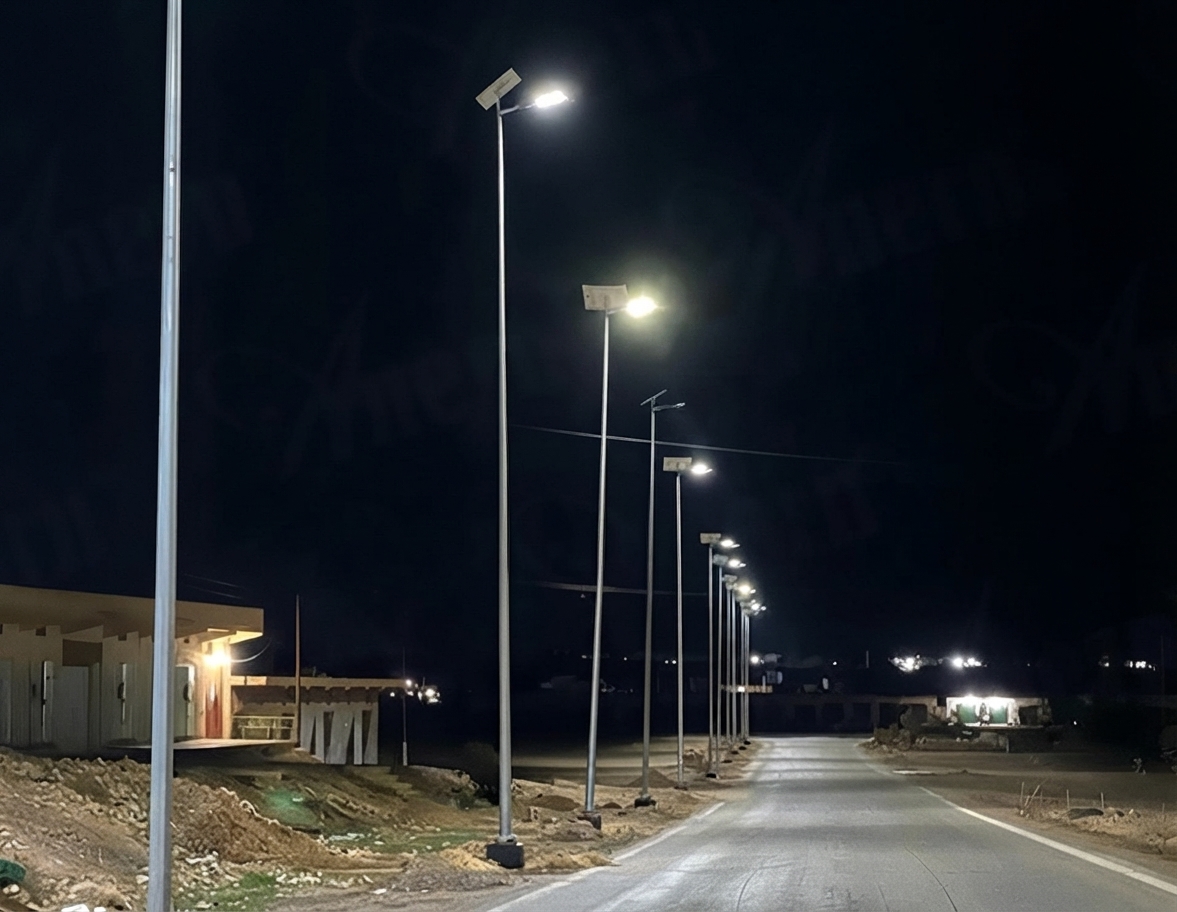
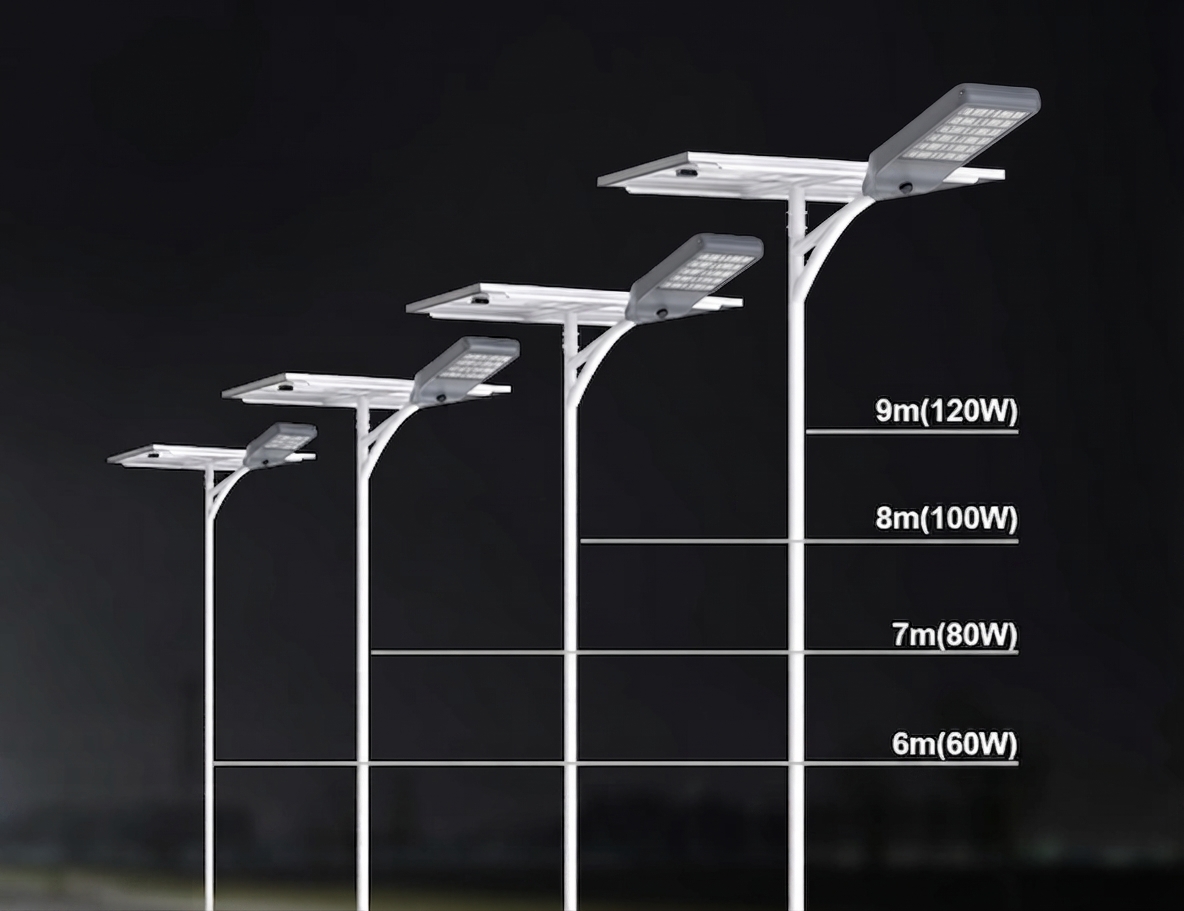
Increasing pole height can allow a luminaire to distribute light across a wider area, but wider coverage does not automatically mean better road lighting.
As mounting height increases, light travels farther before reaching the road surface. A lower pole may provide stronger illumination near the fixture but cover a narrower area. A taller pole can create broader distribution, yet unsuitable optics or excessive spacing may still leave weak zones between poles.
Pole height can also influence glare, visual comfort and uniformity. For a highway solar street light, mounting height therefore needs to be considered together with roadway width, lane configuration and the photometric distribution of the selected luminaire.
The engineering question is not simply “How tall should the pole be?” but “How does this mounting height work with the optic and road geometry?”
Pole spacing determines how effectively the light from adjacent luminaires overlaps. The goal is not only to illuminate the pavement directly beneath each lamp, but also to maintain useful visibility between poles.
| Design Factor | Why It Affects Spacing |
|---|---|
| Pole height | Changes the area reached by the luminaire |
| Light distribution | Controls forward and lateral light spread |
| Road width | Changes required cross-road coverage |
| Illuminance target | Defines how much light must reach the pavement |
| Uniformity | Limits acceptable dark areas between poles |
| Pole arrangement | Changes how neighboring light patterns overlap |
Rules such as spacing being a fixed multiple of mounting height may help during early planning, but they should not be treated as universal standards.
Two luminaires installed at the same height can require different spacing because their optical distributions may be completely different.
An 8-meter pole beside a 6-meter road does not face the same lighting task as the same pole beside a 10- or 14-meter road.
On a narrow road, a single-side layout may provide enough lateral coverage. As road width increases, reaching the opposite side while maintaining adequate uniformity becomes more difficult.
Several changes may then be necessary:
Pole arrangement may change. Wider roads may require staggered, opposite-side or median layouts instead of a simple single-side arrangement.
Optical distribution may change. The fixture may need to project more light laterally across the carriageway.
Spacing may need adjustment. A layout that works on a narrow road may create weak zones when applied unchanged to a wider roadway.
This is why road width should be defined before final pole spacing is approved.
Excessive spacing can reduce the number of poles required, but it often creates poor lighting uniformity.
The area directly beneath each luminaire may remain bright while the midpoint between poles becomes noticeably darker. Drivers then experience a repeating bright-dark-bright pattern along the road.
The problem may not always be obvious from average illuminance alone. A road can have an acceptable average lux value while still containing areas with significantly lower illumination.
Uniformity therefore matters as much as overall brightness. For road and municipal projects, consistent visibility along the entire route is generally more useful than achieving very high brightness directly below each fixture.
Poor spacing can also make obstacles, pedestrians and road edges less consistently visible, particularly where the photometric distribution does not provide enough overlap.
When the area between poles is too dark, increasing lamp wattage may seem like the easiest solution.
Sometimes additional light output is genuinely required. However, higher wattage cannot automatically correct poor geometry or unsuitable optical distribution.
If the fixture already directs most of its light near the pole, increasing wattage may simply make that area brighter while the midpoint remains relatively weak. This can increase contrast rather than improve uniformity.
Before increasing wattage, it is better to examine the relationship between pole height, spacing, road width and luminaire optics.
A useful sequence is to check whether the light distribution reaches the required road areas, determine whether neighboring patterns overlap sufficiently, review the pole arrangement and only then decide whether greater lumen output is necessary.
Higher wattage should solve an output problem, not compensate for a layout problem.
Rules of thumb are useful during early project planning because they provide approximate mounting heights, pole quantities and initial budgets. Final road-lighting design should be more precise.
An IES file contains photometric information showing how a specific luminaire distributes light in different directions. When this information is used in software such as DIALux, designers can model the actual road and evaluate the proposed lighting layout.
Variables can include road width, mounting height, pole spacing, fixture arrangement and luminaire orientation. The resulting simulation can then evaluate illuminance and uniformity before installation.
Anern currently provides IES files and DIALux simulation support for solar street-lighting projects, allowing pole height and spacing to be tested against actual project conditions rather than relying only on generic spacing rules.
This is especially important because two solar street lights with similar wattage can produce very different road-lighting results if their optical distributions are different.
The engineering relationship behind a solar street light with pole is not simply “higher pole equals wider spacing.”
Pole height affects the reach and distribution of light. Road width changes lateral coverage requirements. Pole spacing determines overlap, while luminaire optics control where the available light actually reaches the pavement.
Higher wattage cannot solve every layout problem.
Reliable solar road lighting therefore requires pole height, spacing, road geometry, optical distribution and illuminance requirements to be designed together, with photometric simulation used when project performance needs to be verified.
There is no universal height. It depends on road width, luminaire optics, lighting requirements and pole arrangement.
Spacing depends on mounting height, optical distribution, road width and required uniformity rather than one fixed rule.
Not automatically. Optical distribution and road geometry are just as important as wattage.
Yes. Wider roads may require different optics, pole arrangements or spacing to maintain adequate coverage.
Yes. DIALux can evaluate pole spacing together with mounting height, road geometry and the photometric performance of the selected luminaire.

Bob Wu is a solar engineer at Anern, specialising in solar street lighting and off-grid systems. With over 15 years of experience in renewable energy solutions, he designs and optimises solar-powered lighting and energy systems for global projects. His expertise ensures efficient, sustainable and cost-effective solar implementations.

Make your business profitable
Zero your Electricity bill
Leading the solar solutions industry

 English
  français
  Deutsch
  Español
  italiano
  русский
  português
  العربية
  Türkçe
  Malay
Malay  Indonesia